{{ 'fb_in_app_browser_popup.desc' | translate }} {{ 'fb_in_app_browser_popup.copy_link' | translate }}

{{ 'in_app_browser_popup.desc' | translate }}

Your Shopping Cart is empty.
{{ (item.variation.media ? item.variation.media.alt_translations : item.product.cover_media.alt_translations) | translateModel }} {{ (item.variation.media
                    ? item.variation.media.alt_translations
                    : item.product.cover_media.alt_translations) | translateModel
                }}
{{ 'product.bundled_products.label' | translate }}
{{ 'product.bundle_group_products.label' | translate }}
{{ 'product.buyandget.label' | translate }}
{{ 'product.gift.label' | translate }}
{{ 'product.addon_products.label' | translate }}
{{item.product.title_translations|translateModel}}
{{ field.name_translations | translateModel }}
  • {{ childProduct.title_translations | translateModel }}

    {{ getChildVariationShorthand(childProduct.child_variation) }}

{{ 'product.set.open_variation' | translate }}
  • {{ getSelectedItemDetail(selectedChildProduct, item).childProductName }} x {{ selectedChildProduct.quantity || 1 }}

    {{ getSelectedItemDetail(selectedChildProduct, item).childVariationName }}

{{item.variation.name}}
{{item.quantity}}x NT$0 {{ item.unit_point }} Point
{{addonItem.product.cover_media.alt_translations | translateModel}}
{{ 'product.addon_products.label' | translate }}
{{addonItem.product.title_translations|translateModel}}
{{addonItem.quantity}}x {{ mainConfig.merchantData.base_currency.alternate_symbol + "0" }}
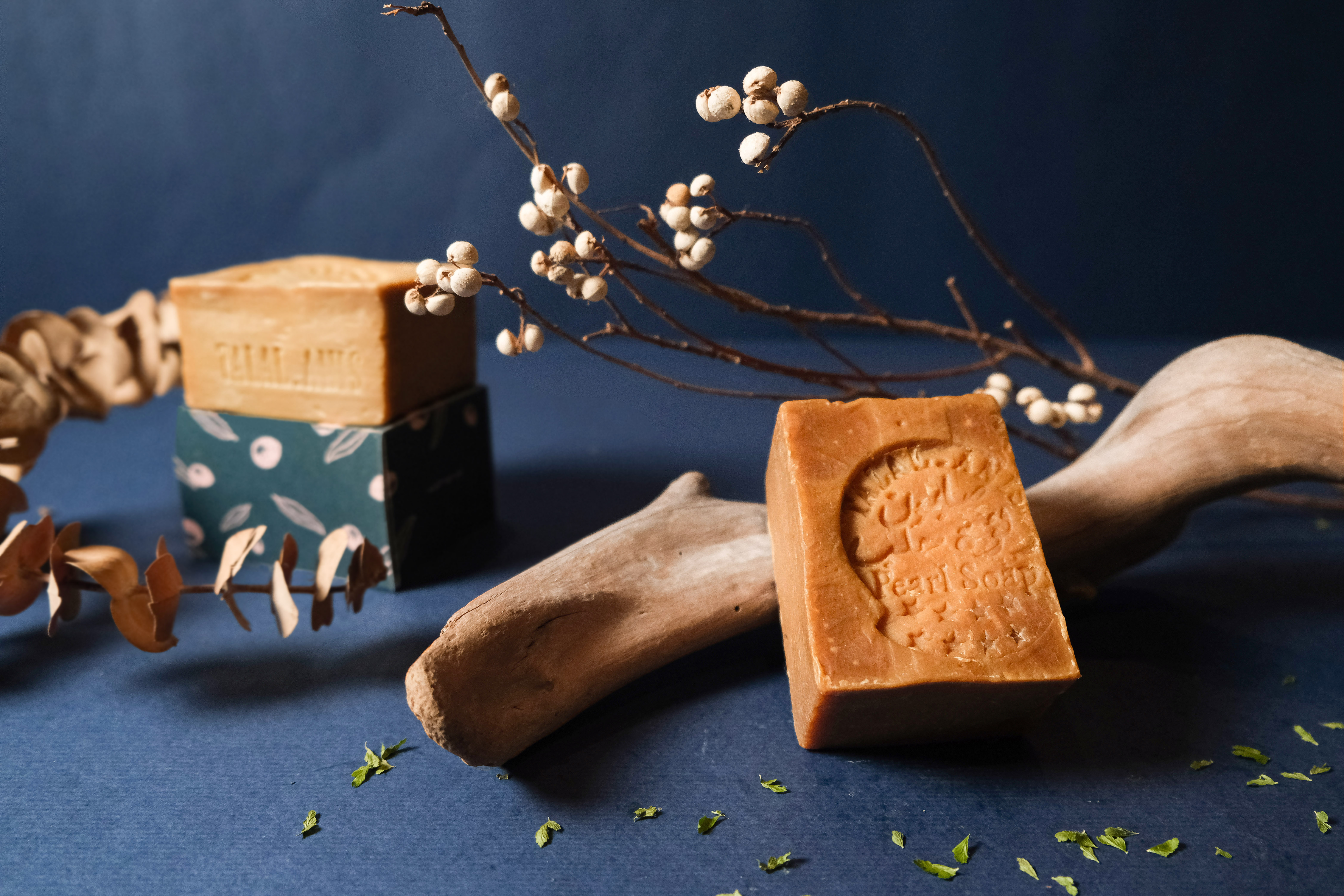
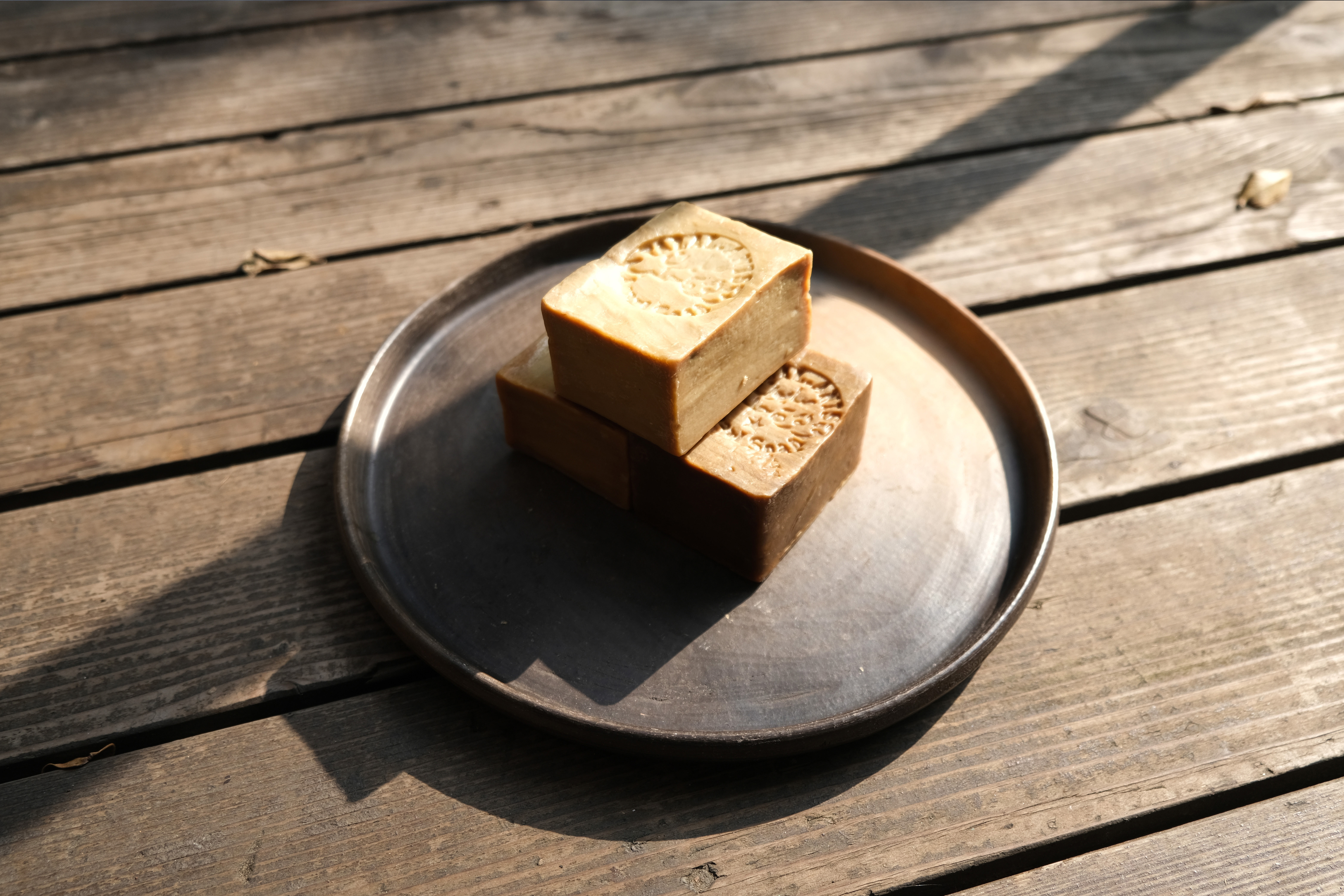
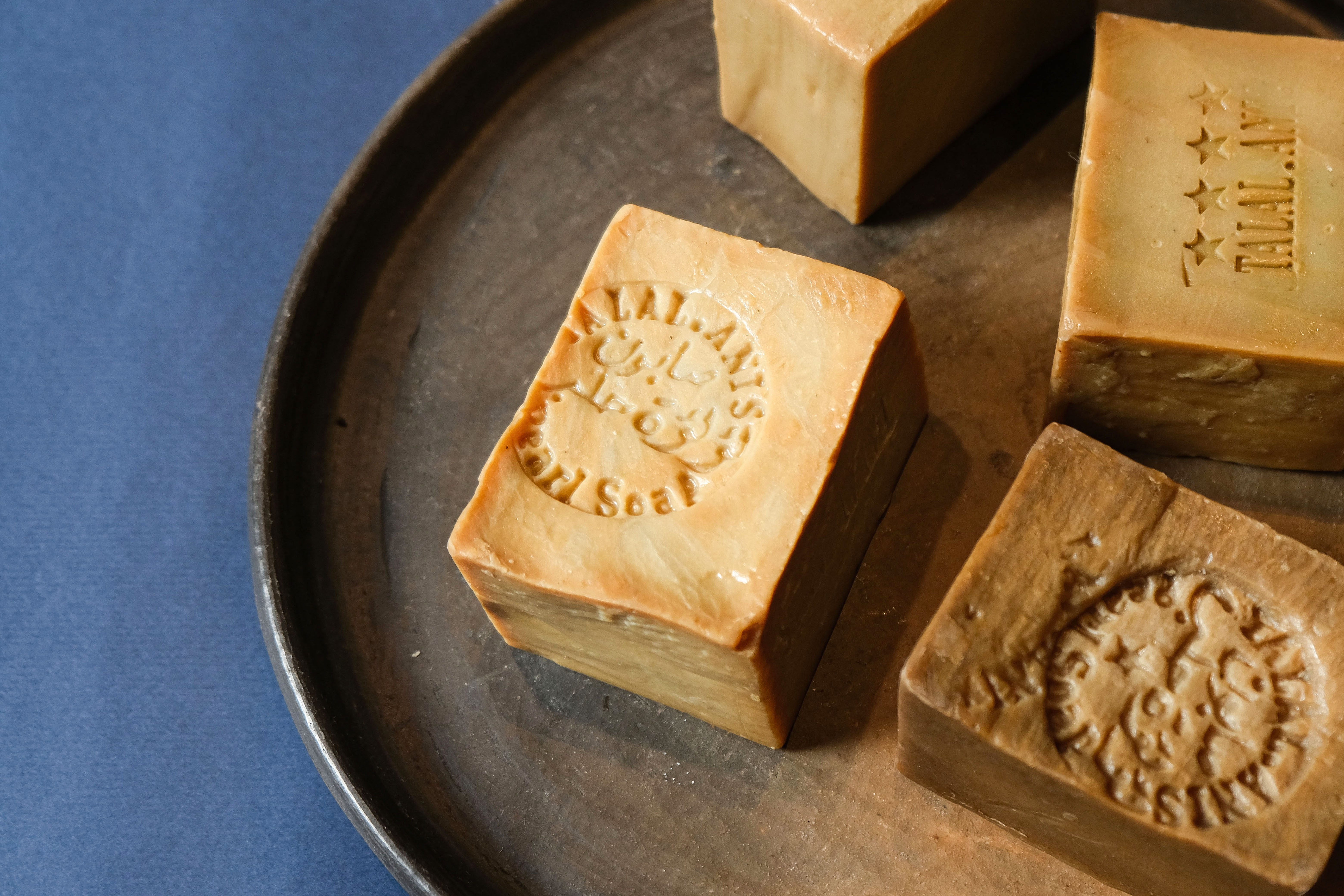
Known as the "Green gold", the ancient Aleppo soap has been produced by ancestral methods for more than a thousand years. With laurel oil and olive oil extracted from bay berries and natural repair and moisturizing power, this is the world's first solid soap.

The world's first ancient soap

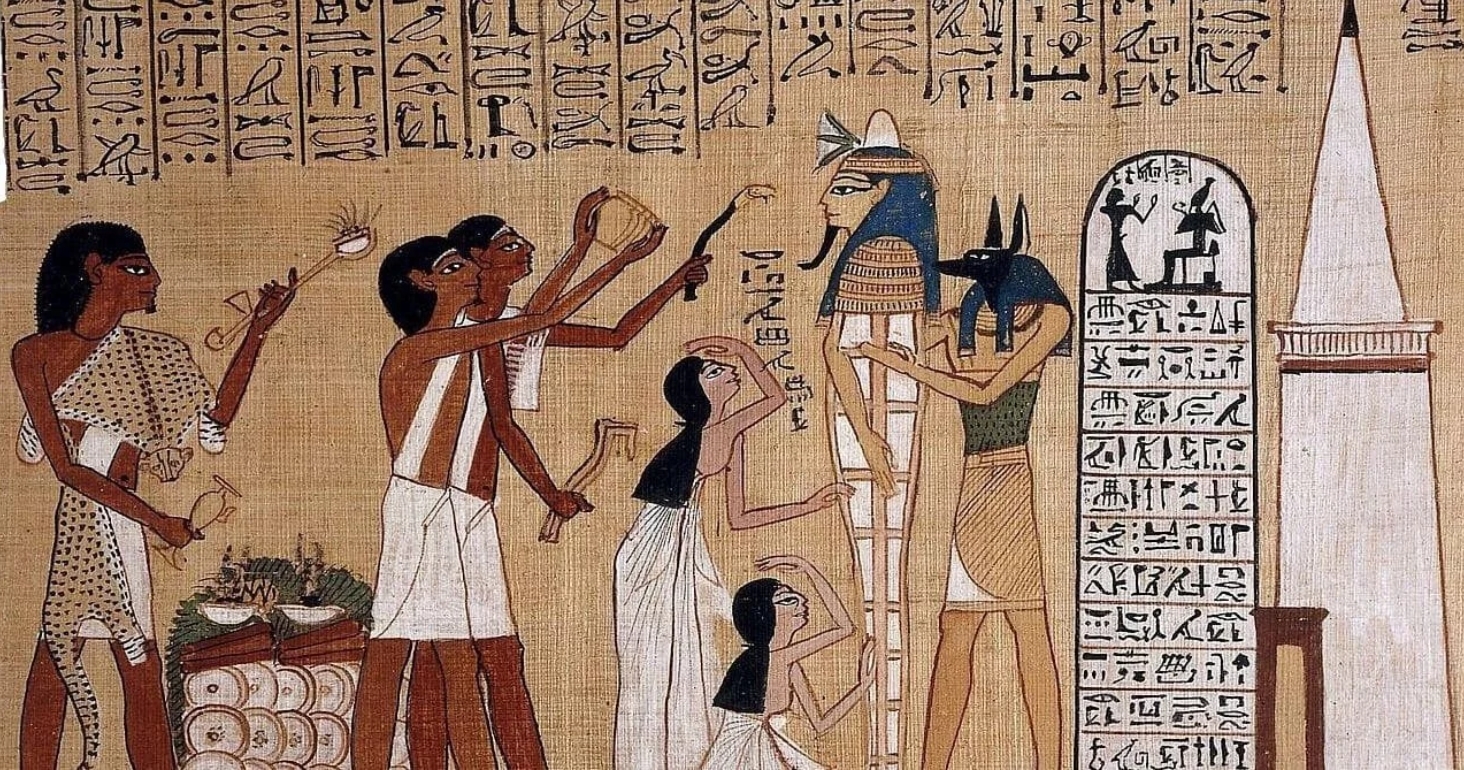
Soap, with 5,000 years of history, started when was discovered that the ashes of burning plants mixed with animal fats could create fine lather to remove dirt. The earliest records of soap date back to 2,000 BC. The ancient Babylonian clay tablets had a soap formula that was a mixture of water, alkali and cinnamon bark oil. The ancient Egyptian papyrus also recorded that people would use a liquid mixture of animal oil, vegetable oil and alkaline to wash the body.

Image / Ancient Egyptian papyrus with records of cleansing and make-up

Source / Ranker

The artisans of Aleppo used the unique laurel oil of the Mediterranean, natural olive oil, alkaline substances and water,  being the ancestors of all soaps. The origins and legends of Aleppo ancient soap are numerous. According to the legend, the Queen of Ancient Syria and Queen of Ancient Egypt used it.  Through the Silk Road trade, the ancient soap of Aleppo spread to the East and gradually became a must-have commodity on the Silk Road. In the Middle Ages, with the Crusades, the ancient soap was introduced into France from Italy and Spain, and was loved by the Europeans.


However, it took 2,800 years for the first solid soap to be made in the town of "Aleppo" in northwestern Syria, in the 8th century.

Image / Making ancient Aleppo soap in a traditional way for thousands of years

Sour / Patrick MERLAY

In the 15th century, Marseille, a town in southeastern France, imitated Aleppo in the making of soap, but Europe did not produce laurel oil at that time, so olive oil and other vegetable oils were used to make the well-known "Marseille soap". 200 years later, the Castilla Empire in northern Spain created the "Castilla soap" entirely with olive oil.  The century-old handmade soaps in Europe have all tried to overcome the lack of laurel oil and inherited the legacy of  the ancient soaps in Aleppo.

Image / The French Marseille soap is derived from the ancient soap of Aleppo

Source / Giuseppe Della Greca

Image / Aleppo ancient soap from Syria

Source / SouSou Corner

A city of beauty and sorrow: the ancient city of Aleppo

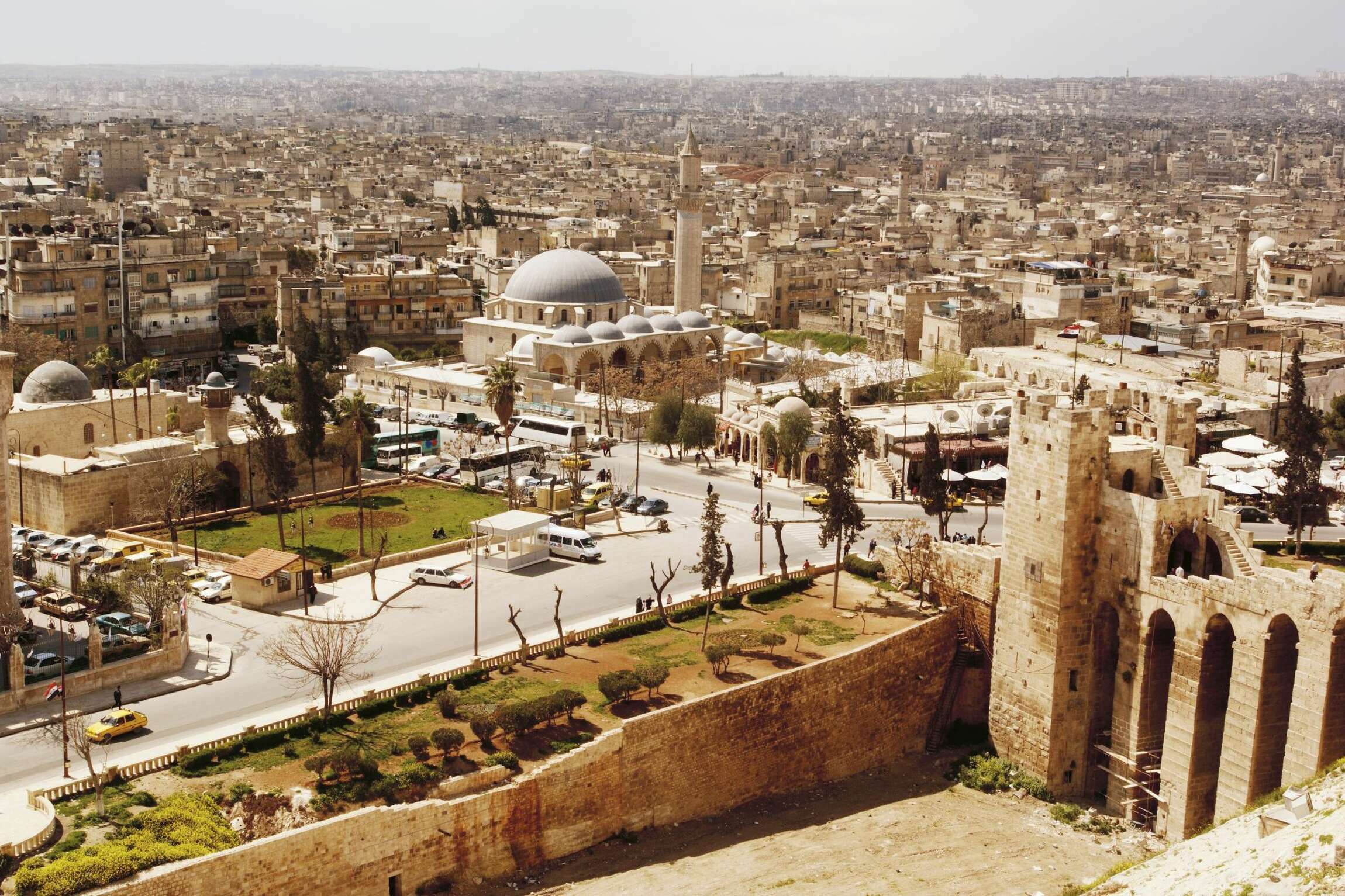
The ancient soap was named after its origin in "Aleppo".  The city of Aleppo is located in the northwest of Syria, in the fertile plain between the Mediterranean Sea and Mesopotamia. Its human civilization ruins can be traced back to more than 5,000 years ago, making it one of the oldest towns in history.


Image / Aleppo before the Syrian Civil War

Source / Chron

In addition to its long history, its geographical location is an inherent advantage for Aleppo, which is located in the middle of the world; it is the final destination of many routes of the Silk Road, connecting the two continents of Asia and Europe. This ancient city brought together all the treasures from various countries, such as Chinese silk, Indian spices, Italian glass, etc. And for thousands of years, it lived on trade and prided itself on prosperity.

Image / Location of the ancient city of Aleppo

Source / SouSou Corner

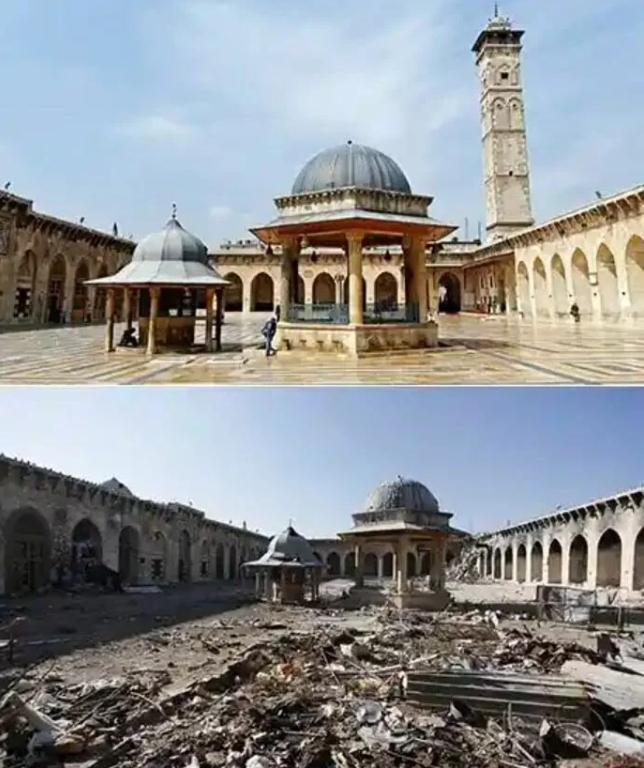
After the rule of many empires such as Xitai, Byzantine and Ottoman Turkey, the ancient city's architecture reflected the diverse cultures and life imprints of previous dynasties and was listed as a World Heritage Site by the UNESCO in 1986. However, the ancient city with a high degree of history and culture has been devastated by artillery shells in the 21st century.

In 2011, under the influence of the Arab Spring, anti-government demonstrations in Syria demanded the resignation of President Bashar al-Assad.  The demonstrations turned into armed conflicts, triggering the intervention of the United States, Russia, Arab countries and other forces, and the Syrian civil war broke out overnight.

Aleppo became a major conflict site because of its important battlefield location.  In December 2016, the Syrian government forces won, finally ending the four-year-long battle of Aleppo.  Today, parts of Syria are still raging with war and the ancient city of Aleppo has been under the rule of the government army and is embarking on a long road of restoration and reconstruction.


Image / What the ancient city looked like before and after the Civil War

Source / Alamy, Corbis

The oldest secret recipe, the most natural raw material - bay oil and olive oil

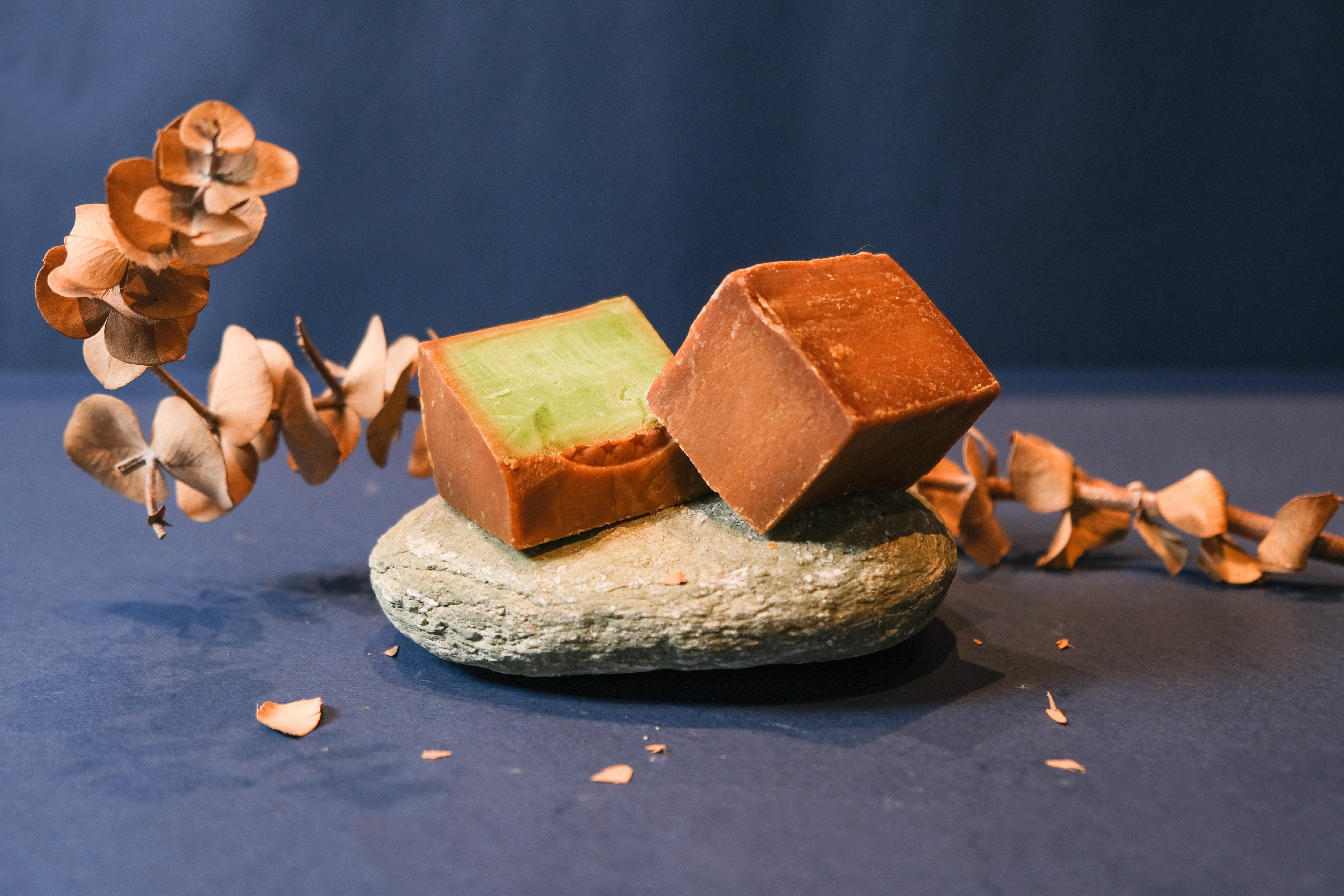
From November to March every year, it is the olive season and the season for making ancient soaps in Aleppo. Only four materials are used for making ancient soaps: olive oil, bay oil extracted from bay berries, alkali, and water. Although different craftsmen may have their own unique processing methods, these are the main materials used in the Aleppo region for thousands of years.  After a year of aging, the soap acquires a brown outer appearance and a clear green inside. The ancient soap can be used to wash the face, hair and various parts of the body. Its bubbles are fine, and it can even be used for shaving.

Source / Gazeterize、Gazetevatan

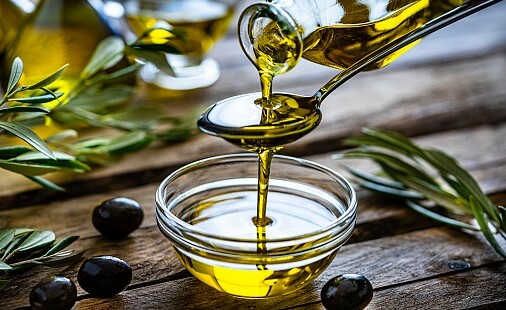
Olive and bay oils are the most important elements of ancient soaps. Olive oil, also known as the Mediterranean manna, is rich in vitamins and nutritional value, and is the core of the Mediterranean diet.  Not only used in dishes, olive oil has natural moisturizing effects and is a must-have product in Middle Eastern countries.

Native to the Mediterranean, laurel is an evergreen Lauraceae crop that usually grows along the coast, above 200 meters above sea level. Every autumn, when bay berries turn black and mature, the Syrian villagers collect the berries and simmer them for 6 to 8 hours to obtain bay oil.  It takes about 16 kilograms of bay berries to produce one liter of bay oil, which is extremely precious and can soothe red, swollen and sensitive skin.

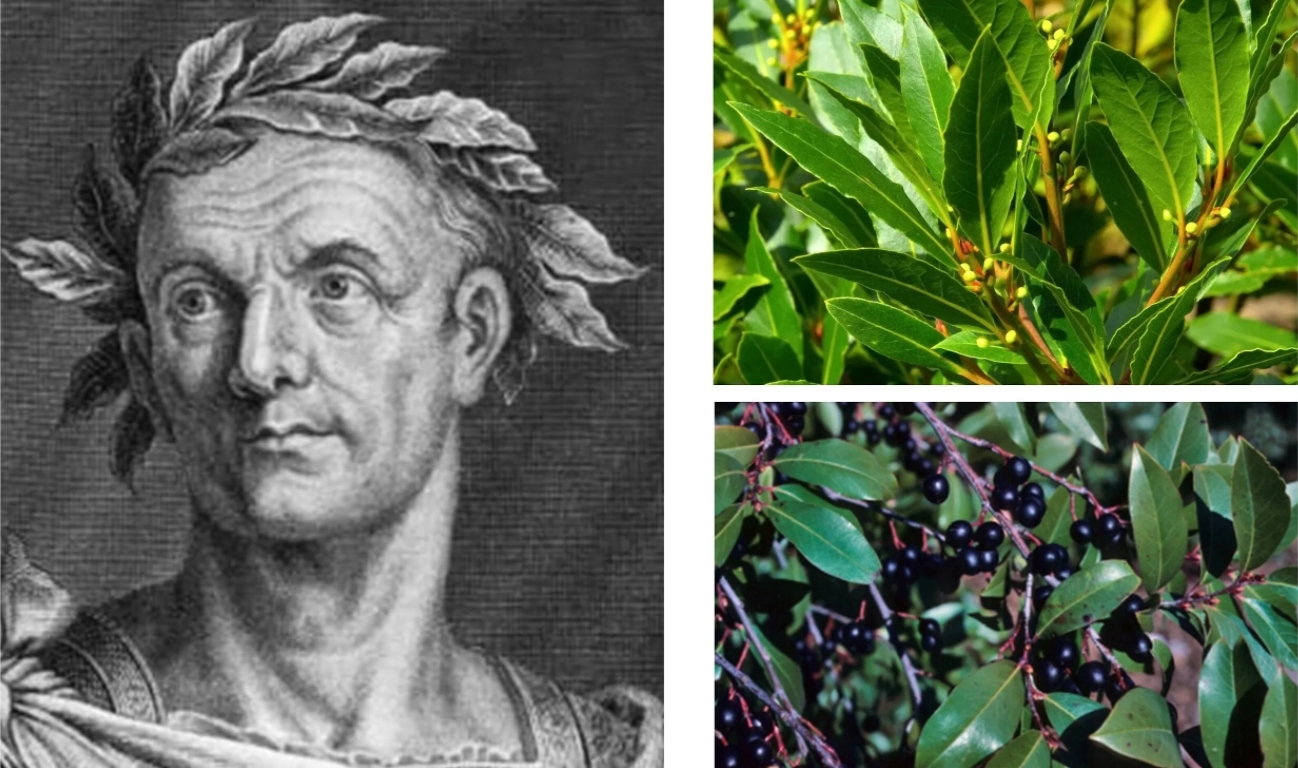
Laurel in Latin is Laudis, which means "praise". In Greek mythology, the laurel tree is the glory of the sun god Apollo, and the leaves and fruits on the tree symbolize the wealth and prosperity of the Mediterranean. In Roman times the laurel wreath woven from laurel leaves was a symbol of wisdom and victory, while the small round black fruits of the tree, the laurel berries, which contain essential oils that are antibacterial and anti-inflammatory, were regarded as the elixir of life in ancient times.

圖/南南之隅以月桂漿果作為阿勒坡古皂的包裝設計
拍攝/南南之隅

Image / Julius Caesar wearing a laurel crown with bay leaves and bay berries

Source / Simmer for about 20 hours with constant stirring

Production of the ancient Aleppo soap

The Aleppo ancient soap is an important traditional craft in Syria. In order to protect the ancient soap industry, the Syrian government has a strict definition of the origin and process of the ancient soap. Only the soap produced in Aleppo and three other towns can be called "Aleppo Ancient Soap". Before the outbreak of the Syrian civil war, Aleppo produced about 30,000 tons of ancient soap every year. However, the ancient soap industry was severely hit by the destruction of artillery shells. Some soap makers chose to leave their homes and move to neighboring countries such as Turkey, Germany, and France to continue the way of making soap preserved for thousands of years.

The craft of Ancient soap 
Step 1 - Cook on high heat

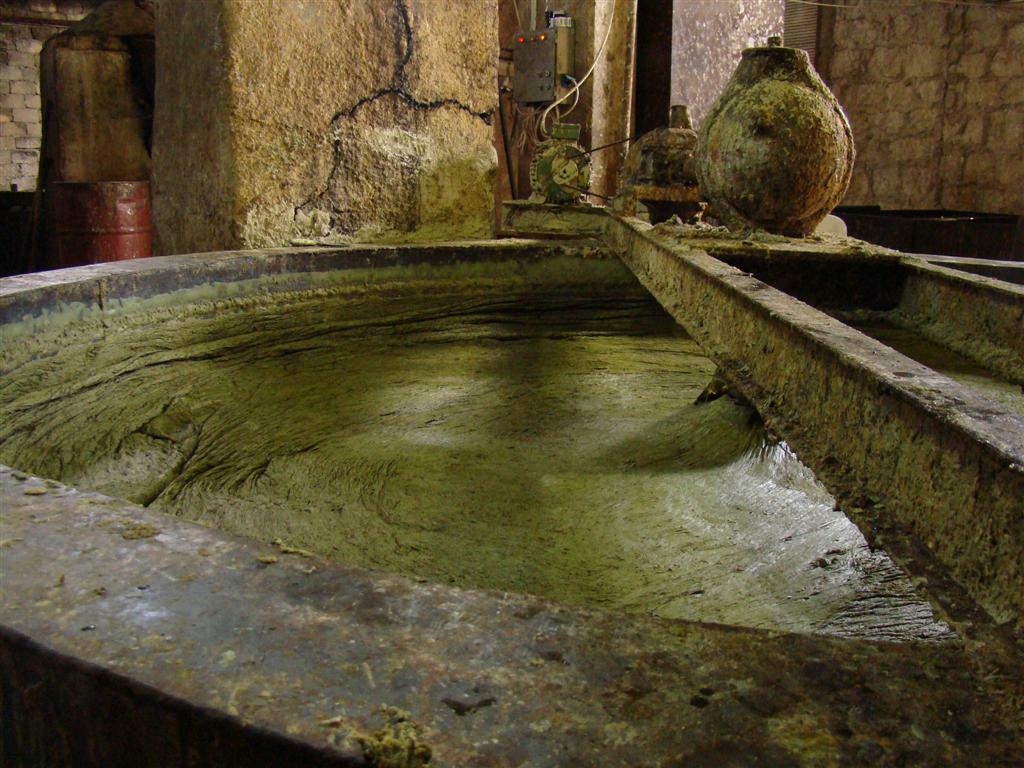
The traditional Aleppo ancient soap is stewed in a huge boiler. It is necessary to mix water, olive oil and alkali evenly at a high temperature of 120 degrees, and stew it for up to 20 hours. It also needs to be stirred continuously by manpower.  After a good fortunate reaction, it becomes a viscous liquid soap.  At the end of the simmer the bay oil is added and it is given a last stir.

Image / Simmer for about 20 hours with constant stirring

Source / Francis

Step 2 - Cool down

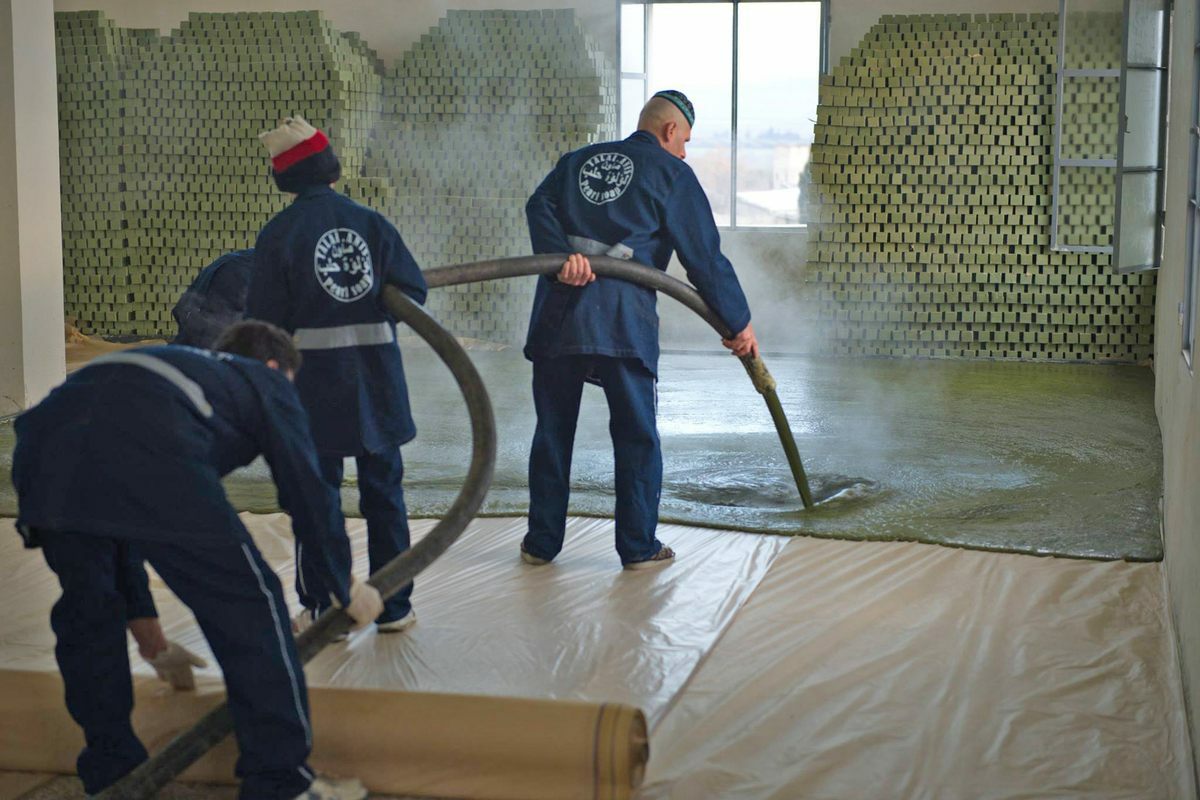
The traditional ancient soap craftsmanship has a unique architectural design. The burning pot is located on the upper layer, followed by a pipeline, and the lower layer under it is the cooling chamber. The hot, liquid mixture is spread on the flat open space specially used for cooling the soap by gravity.  During the cooling process, the soap makers walk through with wooden boards tied to their feet to make the thickness even.  Experienced craftsmen can confirm the quality of ancient soaps by the smell.

Source / Porosenka

Source / GeographyEducation

Step 3 - Cut the Stamp

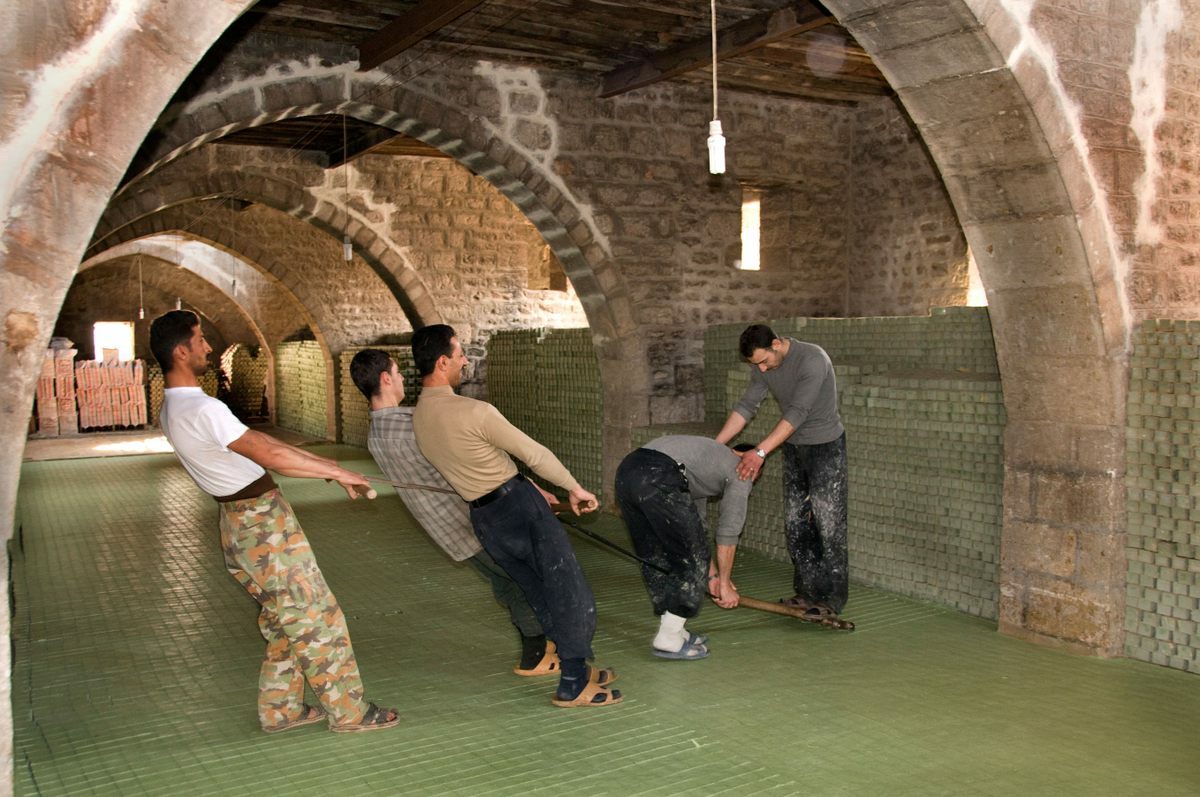
After cooling for about a day, 4 or 5 craftsmen will wear sharp-edged wooden boards and tie them to their feet to step on the soap and cut it back and forth like a ploughing field.

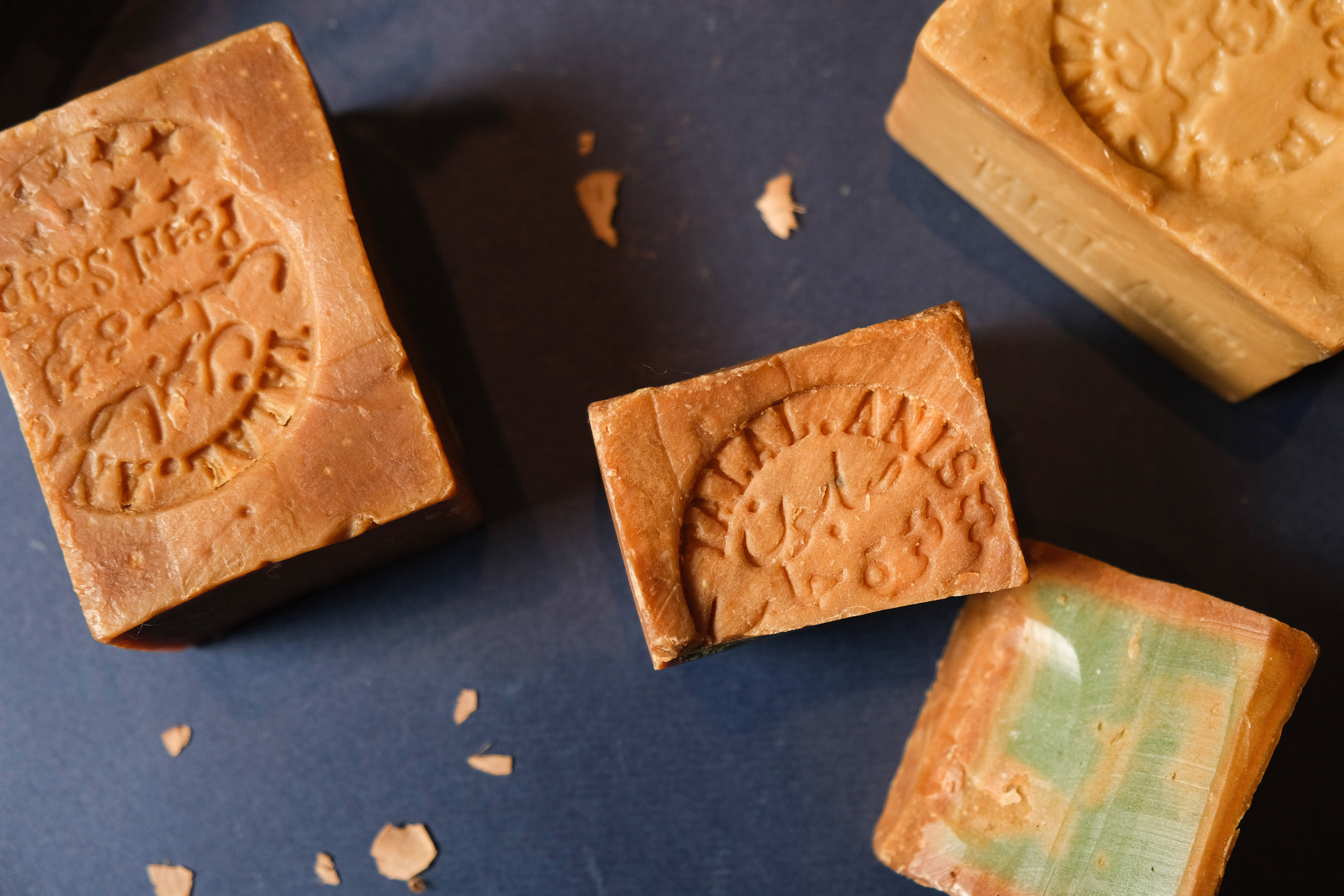
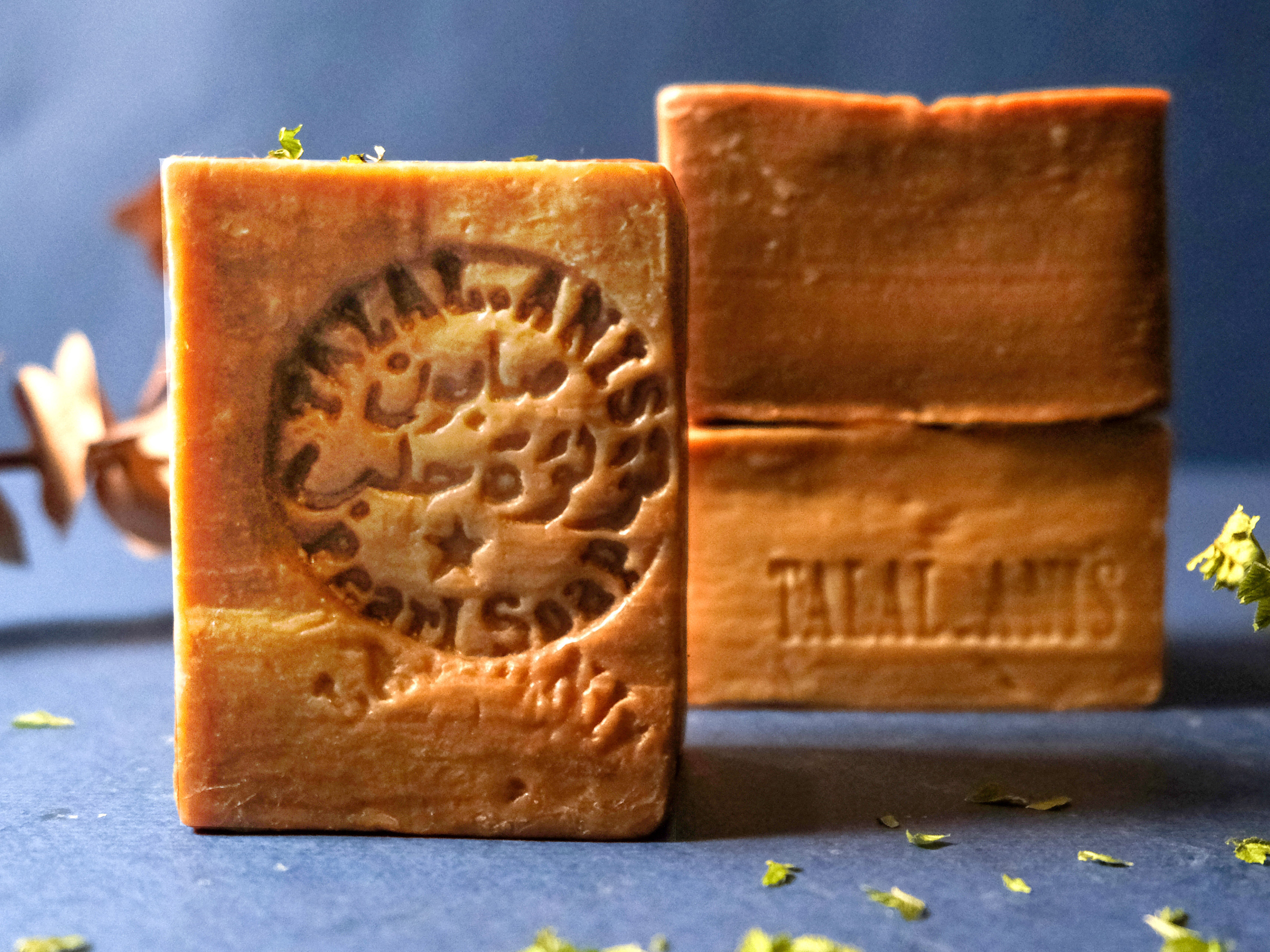
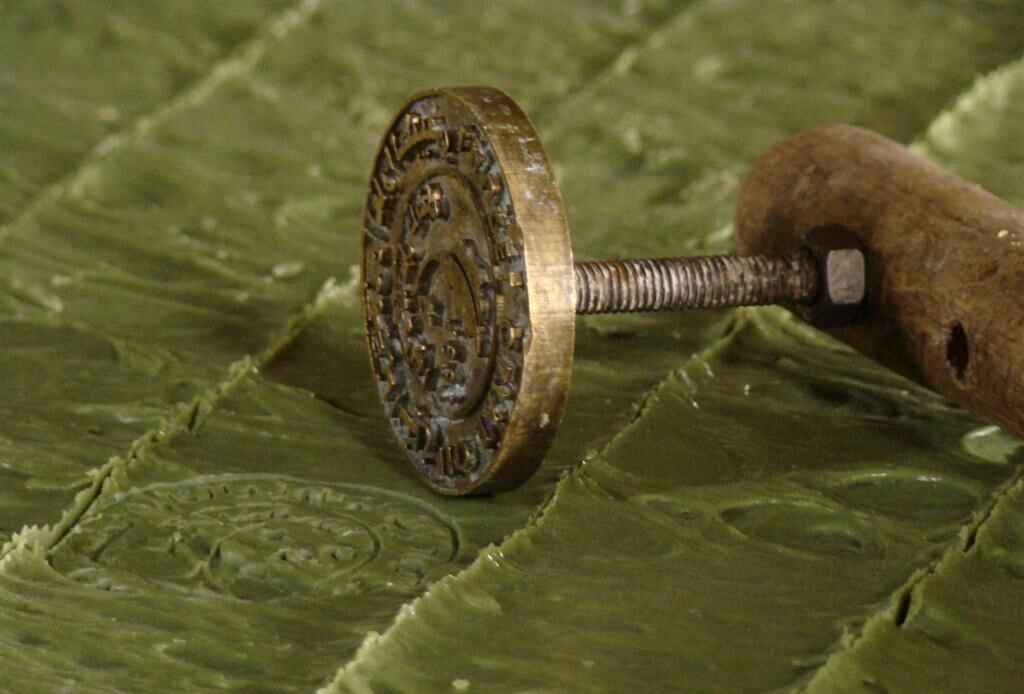
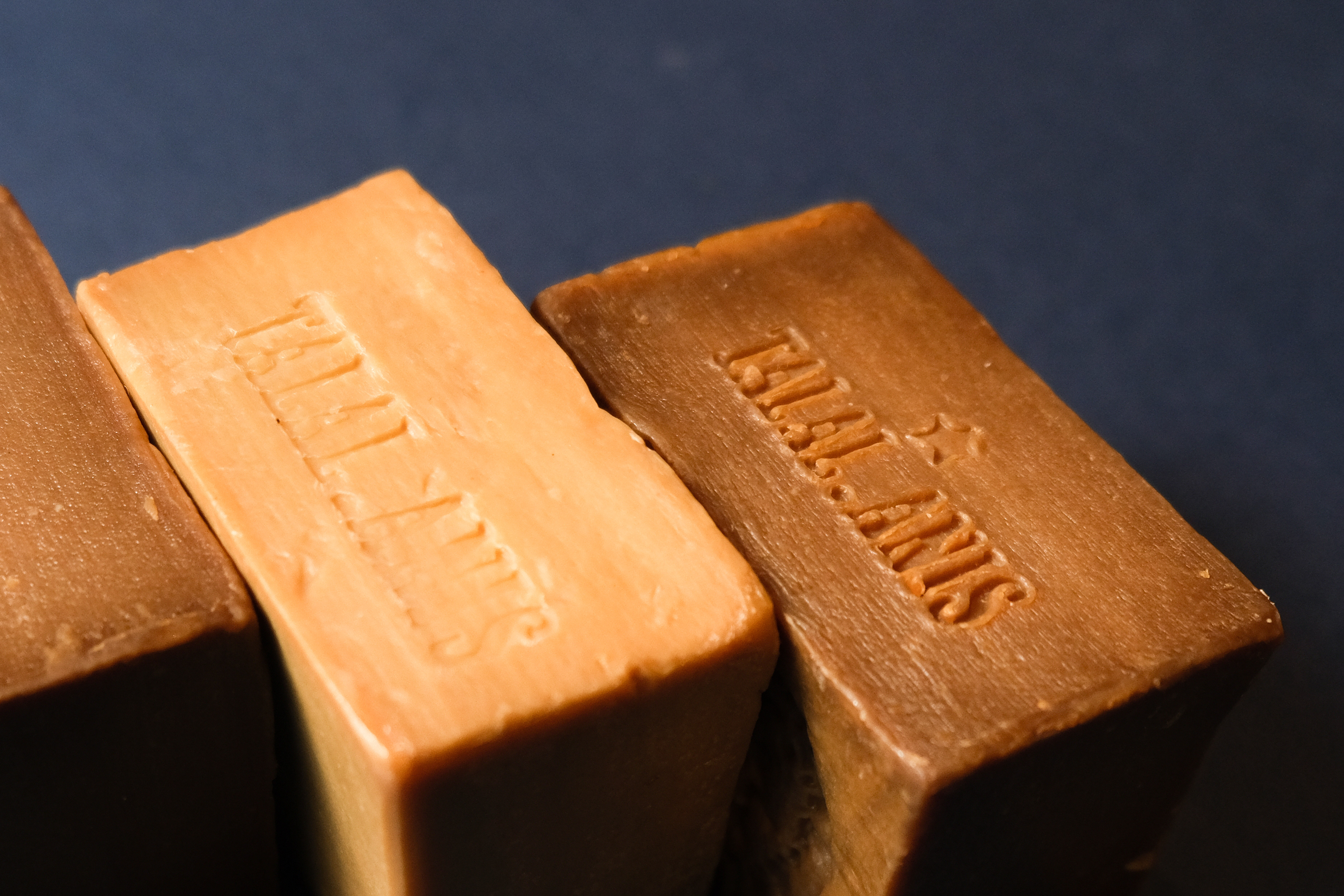
The cut ancient soap also needs to be stamped with the exclusive seal of Aleppo ancient soap. This process is highly dependent on manpower. From the corners and seals of the ancient soap, it can be seen that some are skewed and some are blurred, which are all artificial results.

圖 / 古皂上的登記章及星星印記
來源 / 南南之隅

Image / Craftsmen use manpower to push and pull back and forth to cut the ancient soap
Source / PETER HORREE  ALAMY

Image / The ancient soap mark of Aleppo with the Arabic "Aleppo" written on it
Source / Francis

Step 4 - Maturation and Saponification

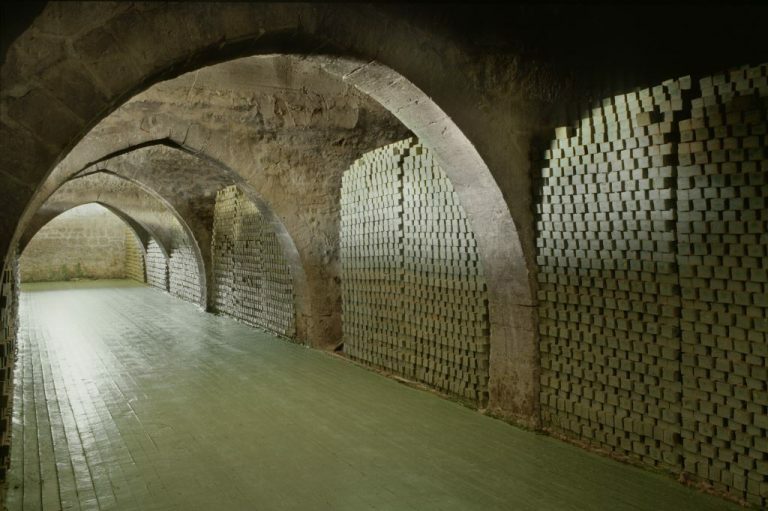
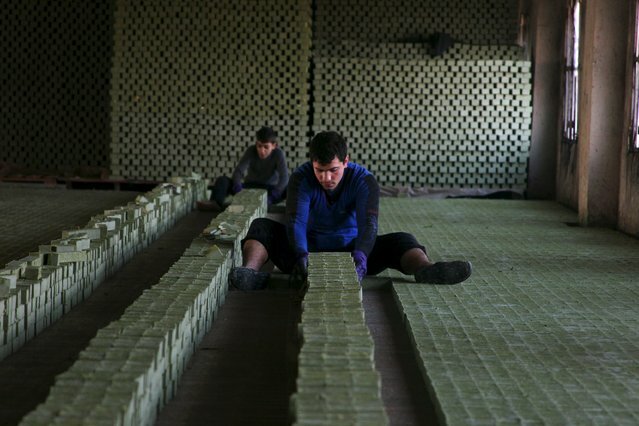
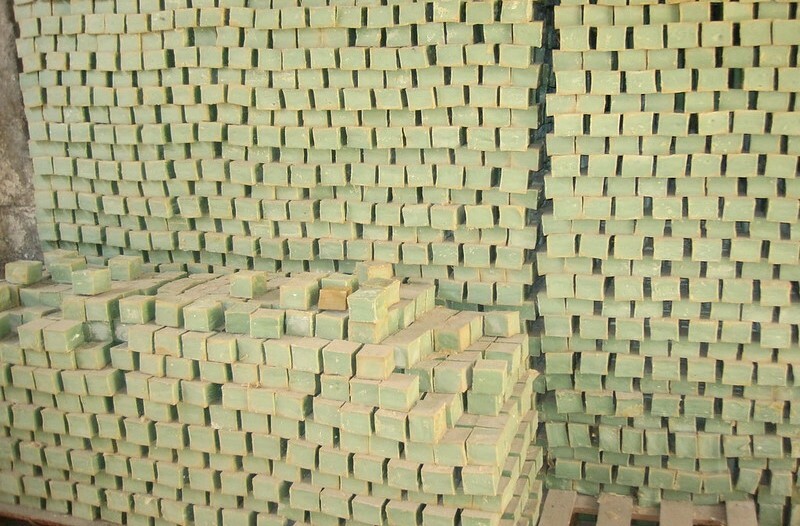
Finally, the ancient soaps produced are stacked one by one with gaps, and it takes nine months to one year to dry and mature. The soap body is dried and oxidized with air contact, while the surface gradually turns brown and the middle a tender green.  The older the soap, the darker the color and the more obvious the growth rings in its middle.

Image / The master who is sorting out the pile

Source / Twelve Colonies

Image / A vertical stack of maturing ancient soaps

Source / SyrianSindibad

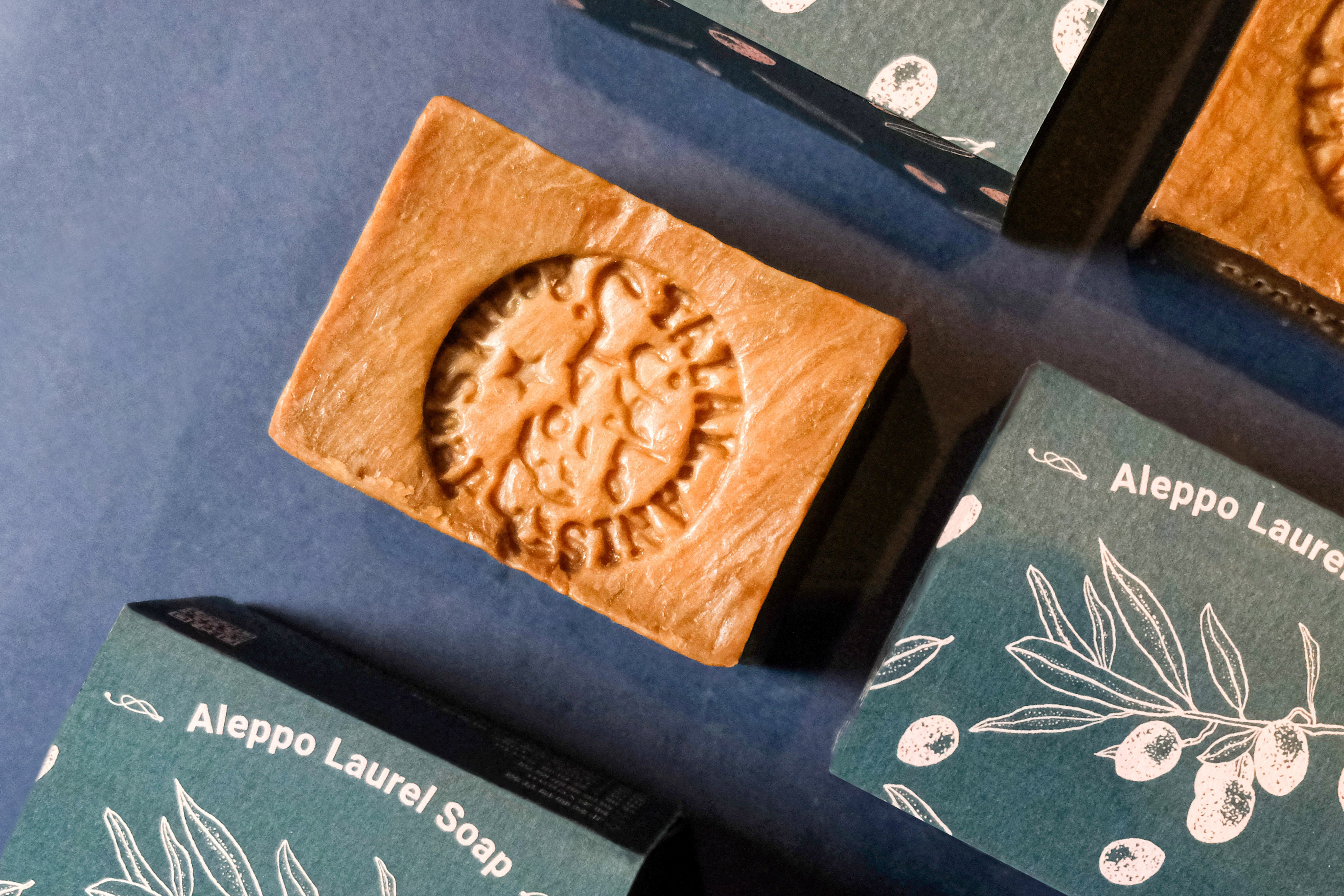
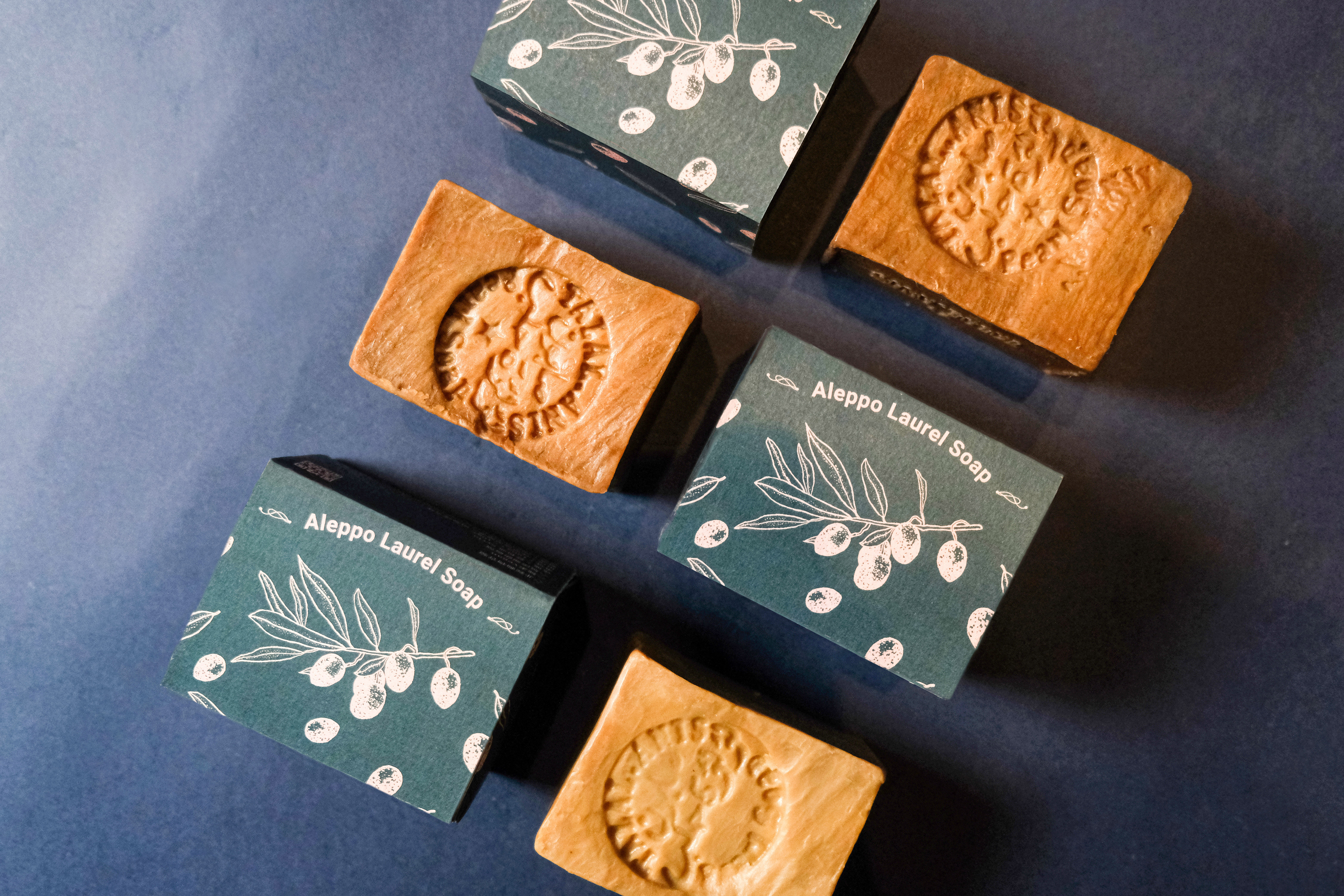
Aleppo Laurel Soap

  • Aleppo handmade soaps come from Siria. They are crafted with traditional methods and by combining pure natural bay oil and olive oil.
  • Laurel oil has antibacterial and anti-inflammatory effects. Because it is relatively rare and expensive, its cost will increase depending on the proportion used to craft the soap.
  • The lower the proportion of bay oil, the higher the proportion of olive oil. This will increase the moisturizing effects of the soap. Depending on their skin type, you can choose the type of ancient soap that suits you better.